Friday, March 27, 2020

Parshat Vayikra

Another brief d'var for the Or 'Ammim website. If you're interested, you may read the Italian version here.

Parshat Vayikra
27.03.20

This Shabbat we begin a new book of the Torah - Vayikra. The Mishkan (Tabernacle) has been built, and now the presence of God can dwell amid the people. This week’s portion describes the 5 different korbanot(sacrifices) that must be offered to God in order to maintain and restore the relationship between us. Since the desert wanderings of the Children of Israel are over, and the Temple in Jerusalem has been destroyed, we are no longer able to bring these offerings of animals and grain. How then may these words of Torah be relevant to our life in Italy today?

The Hebrew word for sacrifices is korbanot. The root is karav, to draw near or come close. For our ancestors, this was their way to connect with their God, to express their desire to be in a positive relationship. After the debacle of the Golden Calf, God realized that we humans have a great need for a physical sense of connection, through our senses. Thus God appeared to the Israelites as a pillar of smoke during the day, and a pillar of fire by night, leading them through the desert. God designed the Mishkan as a place where God’s presence could rest among the people. And the ceremony of the sacrifices – the sounds and smells of the animals being slaughtered, the priests tasting their portions, the feel of the grain in one’s hands – made it all so very real. The people were communicating with God, through sin offerings, guilt offerings and peace offerings.

We have no Mishkan here, and cannot follow the instructions as originally intended. Neither is there a Temple any more. However, after the destruction, our leaders taught us that we can still connect with God, we can still come close. Rather than bringing our offerings to the priests so they can follow the very detailed instructions, we can speak to God directly, ourselves, through our prayers. 

The prayerbook tells us what to say in our prayers. But that is just when we go to the synagogue. It is also possible to speak during our everyday lives. In this time when we are all more physically distant, we are lucky that technology can help us maintain social connections. At the same time, having been locked down for so long is making us all more anxious and tense. There is real danger out there and we are afraid of its touch. Our instinct is to withdraw, to protect ourselves. But if our fear makes us abandon our most important relationships, as we see with the Children of Israel at the foot of Mount Sinai, we can lose our way completely. Of course we must stay safe. But we can also stay in touch.

Perhaps the 5 korbanot listed in our portion might correspond to 5 words and phrases that are part of everyone’s daily life. Saying please, or thank you, I’m sorry, I love you; or just hello. It’s not easy to talk to God, especially when you may not be sure if God actually exists, or if God is listening. So let us practice by starting conversations with each other. Please would you share your challah recipe? Thank you for sending that Zoom tutorial! I’m sorry I sounded grumpy. I just called to say I love you. I just called to say hello. The Torah is telling us that we must find ways to come close to each other. Our korbanot are deeds that connect us to each other. As we experience how we are present in each other’s lives, we may begin to notice the signs that God is also in our midst, waiting to hear from us. 

Shabbat shalom.

Tuesday, March 24, 2020

Living under Lockdown Day 17 - Horseradish

Last year I discovered how hard it was to find raw horseradish in Modena. There was nothing in the supermarket, and even the famous Albinelli market gave me no joy. We had to rely on a friend in Bologna to bring something to the Seder. This year our Seder will be small (just L & me & Sara the Cat), but we shall be Zooming with our friends in Bologna and beyond. Thus, it was thrilling to go through the international section of Conad (La Rotunda) and spot this little jar on a shelf. Hurrah! We have our bitter herbs!!


Sunday, March 22, 2020

Living under Lockdown Day 15 - Home School

I have learned to love including cardamom seeds in my apple compote, and today for lunch L put some in the delicious zucchini she made. It got me thinking - how many ways might there be to use cardamom. And this came to mind:  


Friday, March 20, 2020

Living under Lockdown Day 12 (extra) - the Indigo Girls

The power of two women, our dear Amy & Emily, giving a concert from home on FB tonight ... although reception drifted in and out, at one point I think there were 60k people tuning in. Sixty thousand people! Lovely to hear songs old and new, and to see how many of my FB friends from several different eras of my life and all across the world, how they were listening too, singing along ... what a wonderful hour together. Grazie mille Indigo Girls!


Thursday, March 19, 2020

Living under Lockdown Day 12 - Bidet

From the inside looking out, it seems like a lot of people are knocking Italy at the moment in terms of how the government and the people are dealing with the current crisis. I'm sure some mistakes have been made, and if so, hope that those further down the pike will learn from them and help to save more people. Meanwhile, as toilet paper memes flood my social media pages, and trying to accentuate the positive, here's a message from me and Sara the Cat:


Monday, March 16, 2020

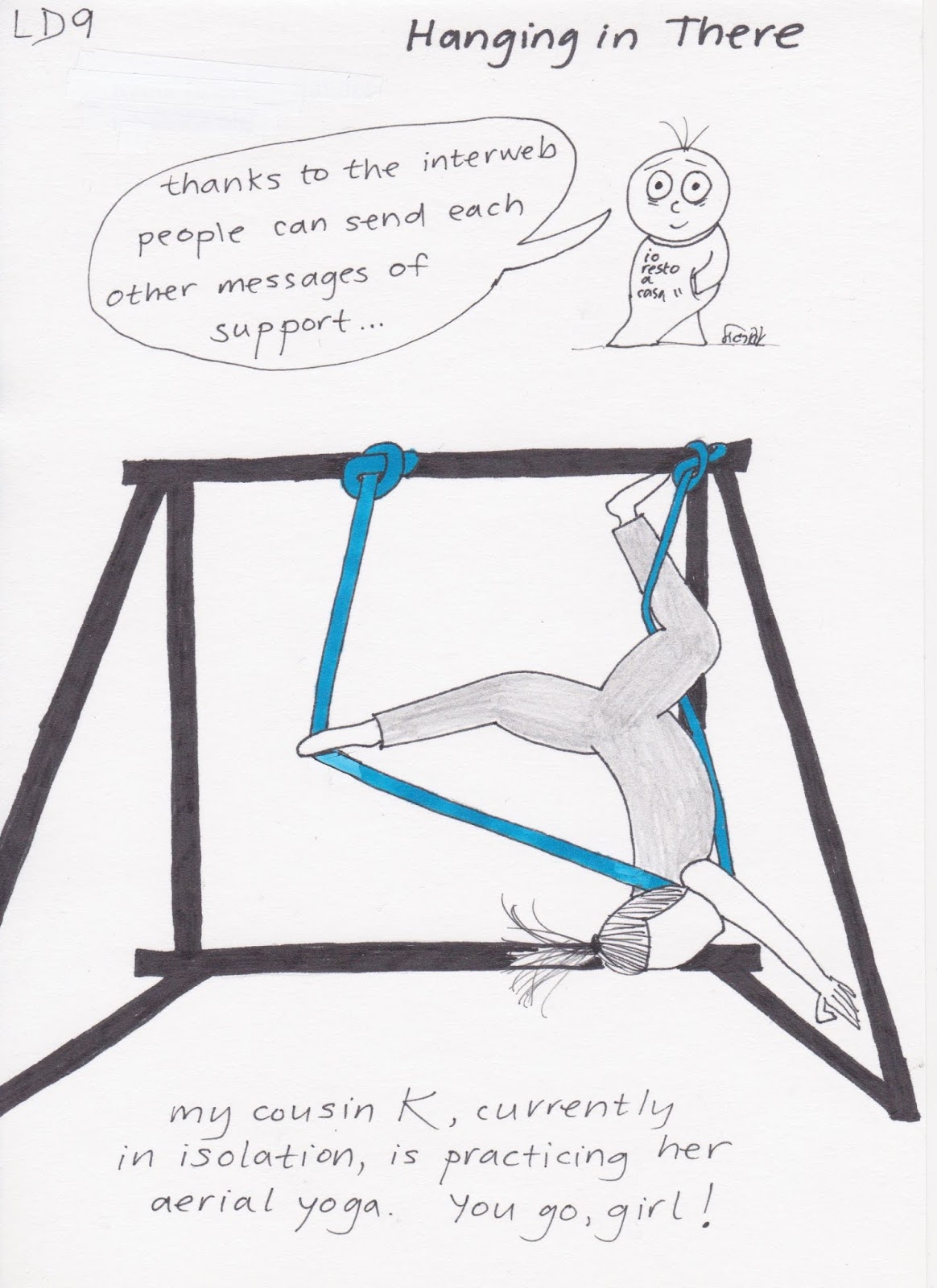
Living under Lockdown Day 9 - Hanging in There

Yesterday on FB my cousin posted a video of how she is using her time in isolation to practice her aerial yoga. I froze the vid and tried to draw what I saw. I hope she doesn't mind!


Sunday, March 15, 2020

Saturday, March 14, 2020

Living under Lockdown: Day 5 - the Sneeze

Maybe this happened to someone I know


Parshat Ki Tissa

Since we cannot meet in person at the moment for Shabbat and Festival services, or study together, we thought that even if there is physical distance, there does not have to be spiritual distance (as noted by several of my colleagues this week) and so I wrote a brief comment on the weekly Torah portion, Ki Tissa in the book of Exodus. We posted the Italian version already - here is the English just in case. 

Via San Giacomo today. The banner reads "andrà bene", it will get better.

Parashat Ki Tissa

Greetings from Modena! As we enter Shabbat, here is a thought that came to me while looking at the Torah portion.

“When the people saw that Moses was so long in coming down from the mountain, the people gathered against Aaron and said to him, ‘Come, make us a god who shall go before us, for that man Moses, who brought us from the land of Egypt, we do not know what has happened to him.” (Exodus 32:1)

This week, while Moses is up high on the mountain, receiving instructions from God for the life of the community, the people lose hope. Moses has been gone a very long time, and the Children of Israel fear for their future. They cannot wait for him any longer, and decide to make their own god, a god that they can see and touch. This Golden Calf does nothing for them, except get them into trouble.  When Moses does come back down the mountain, and sees what they have done, he smashes the two tablets of stone into pieces. He melts their calf of gold, and makes them drink it. Then, God sends a plague upon the people as punishment for what they had done. Ultimately, they are forgiven, and God offers to replace the tablets of the Law that Moses had broken.

I absolutely do not believe that a pandemic such as Covid19 is in any way a punishment from God for anything any human beings may have done. I don’t think that is the way things work. I cannot give you a reason for why this virus began. But, rather than wasting time looking back and trying to place the blame somewhere, I prefer to think about what we can do now. I think the Children of Israel definitely needed to do something. The problem was that they made a bad choice. We too are waiting. We are also anxious, and  frustrated. So what can we do? What choices will we make?

Later in our portion, God comes down in a cloud, and stands together with Moses saying:  “Adonai! Adonai! A God compassionate and gracious, slow to anger, abounding in kindness and faithfulness.” (Exodus 34:6). These words tell us all we need to know.

Our tradition teaches that human beings are made in the image of God. Like God, let us be compassionate and gracious. Let us be slow to anger, and abounding in kindness. If we go to the supermarket, and must wait 47 minutes before it is our turn to enter, let us not show our frustration in how we behave with the other customers and the people at the checkout counters. If we are staying home, let us reach out to others by internet and telephone. Do you know an older person, or someone who lives alone? Give them a call and ask how they are doing. Above all let us try to be patient, and follow the instructions that are designed for the life of our communities, of our country.

We are together. We are Or ‘Ammim.

Shabbat shalom
Rav Ariel, LiOr & Sara the Cat

(if you'd like to see the Italian of this, click here. Thanks to LiOr for all her help!)

Thursday, March 12, 2020

Living Under Lockdown: Day 4

Today's procrastination took the form of finding my favourite fountain pen and doing a bit of drawing.


Sunday, March 01, 2020

Remembering 4-F

Guthrie's anti-Vietnam-War song from 1967
Growing up in London, I was lucky enough to have a father who was able to explain some of the differences between American and British English. His record collection also provided a small window into US popular culture of the 1960's, which is how I came across Arlo Guthrie's song "Alice's Restaurant". At one point I was able to recite the entire piece, all 18 minutes of it. Luckily for my friends, a receding memory now limits me to only a few highlights. 

It was "Alice's Restaurant" that introduced me to the concept of the draft for the Vietnam war, and how Guthrie was ultimately rated 4-F (in fact this was just for the song. It seems that his rating was 1-A, but his lottery number never came up so he did not serve). That designation came to mind many years ago when I interviewed for my first North American pulpit. After applying to c. 18 different communities across the country, the night before Matching Day one of my thesis professors called me and said I should not expect any callbacks as I was too "other" for the American rabbinate. In a moment of wry humour I designated myself 4-F for the American rabbinate, the 4 F's being: Foreign, Female, Fat & a Feigele.

Nu, last week I happened to find out what the origin of 4-F is supposed to be. I knew that with regard to its use in US military language, it was a classification given to someone not acceptable for service in the armed forces for medical or other reasons (e.g. homosexuality). I read that it goes back to the Civil War/War between the States. In order to load a rifle quickly the gun powder cartridge needed to be ripped open with one's teeth. The teeth in the back of the mouth were no good for this task, only the front teeth could be used. The rule was that one must have at least 4 front teeth with which to tear the powder packages open. 4-F.

Shavuatov.

Sunday, February 16, 2020

A Perennial Problem for People, but Kindness is the Answer

I hope you can listen to this clip from Laura Whitmore's BBC Radio 5 Live show today. If not, she was speaking about the death and life of her friend Caroline Flack, who is believed to have taken her own life yesterday at the age of 40. 


Whitmore, and others today, are trying to open our eyes to the power that mean people have on social media and in several forms of journalism. Several people feel strongly that, while Caroline Flack may have had mental health issues and other pressures about which none of us know, the various media posts and articles highlighting her problems were unkind, unnecessary, and might have contributed to her desperation. It is certainly true that there are many cowards who hide behind their keyboards spewing vitriol anonymously at public and private people. There is also the tabloid mentality, that preys on our weakness for gossip, for which we too need to take some responsibility.

It so happens that while catching up on my Daf Yomi today, I came across the following statement by the rabbis of the Talmud in yesterday's section:

“it is preferable for one to throw oneself into a fiery furnace rather than humiliate another in public.” (Berachot 43b)

It stands out for me today for two reasons:  first of all, it is not new that humans seek to humiliate each other in public. It is only the medium that may have changed. And if our ancestors thought it necessary to teach such a teaching, that suggests it was getting out of hand for them also.

Secondly, when will we learn? If public humiliation has been a perennial problem for people, and humans have always suffered and inflicted suffering in this way, when is it going to stop? Could it be that WE are the ones who finally sort it out? 

Be kind. Be kind. Be kind. And if you are already a kind person, thank you, and is it possible to be even kinder? 


Saturday, February 01, 2020

Have a Beautiful Afternoon in Your Neighbourhood

Tom Hanks as Mr Rogers with Daniel the puppet (AP Photo)
I just watched the film A Beautiful Day in the Neighborhood starring Tom Hanks as Fred Rogers. Although I did not grow up with the TV show, I lived long enough in the USA to know who Mr Rogers was. For those of you who never heard of him, this Guardian review will give you a good introduction. On the Graham Norton chat show last New Year's Eve, Tom Hanks shared 3 rules for a better life, as taught by Mr Rogers:

1. be kind.
2. be kind.
3. be kind.

It's a depressing day for many of my friends today. If you are mourning the UK exit from Europe, or  are incredulous that witnesses will not be allowed to testify at the impeachment, or in any country you are horrified at the choices made by your elected representatives supposedly on your behalf, and the future seems bleak, please, watch this movie. Its teaching is simple, and the message is one of lovingkindness. It is worth 90 minutes of your time.

Friday, January 31, 2020

PS HMD Thoughts Update

Thinking of bikes, this is one of my favourite ones.

My last couple of posts were filled with fine words about Holocaust Memorial Day and my attempt to give it contemporary relevance for the students I am teaching. In fact, what probably had the greatest (if any) effect was an image that came to me in the middle of the class, while I was trying to make an intellectual presentation.

All the kids have bikes, and ride them regularly. I said to them, and as I said this I acted my words out physically using the aisle between the desks as my street, I said, so you're riding your bike down the street, and you want to make a right turn. You turn, and there is a gigantic hole in the road and you fall in and the bike is totalled and your legs are smashed ow ow ow ow ow! OR you're riding your bike down the street, and you see a sign that says WARNING gigantic hole if you turn right. So you don't turn right, and go on your way, with your legs and your bike intact.

What is the point of Holocaust Memorial Day? It is a giant warning sign for you, on your journey. That is why we teach you about the Nazi murderers and their victims. So you will remember what evil is possible, and not take that road. Your journey. Your life.

So that's the image that came to mind. I hope it helped make a connection for a bunch of teenage Italian boys who'd just been dragged by their school to see a documentary about Anne Frank, and had little sense of what that had to do with them.

Tuesday, January 28, 2020

Why it's Important to Remember

the last Red Cross note received from my mother's grandmother, who was murdered in 1942. All that is known is that they went to Riga, then to Stutthof concentration camp. There are no other details on record. Her final message to her daughter expresses joy at the news of her granddaughter's birth. 

Someone on Facebook posted today regarding their feelings about Holocaust Memorial Day. They felt strongly that they did not want to make grief from a dreadful past appear to be the central tenet of contemporary Judaism. They argued that the best way of action is to live a joyous Jewish life, thus making sense out of having survived. I wrote the following in response to that thought:

"This afternoon I shared my previous blogpost with my English language class of 18-year-old Italian young men. The Giorno della Memoria is taken very seriously in Italy. For at least one week beforehand, the television and other media are full of programmes and articles related to it, and there are public events in towns and cities across the land.

In class today I spoke to Alessandro, Singh, Riccardo, Luca, Mohamed, Matteo, Issam and others. I shared a brief version of the short life and cruel death at Buchenwald of my great-uncle Hermann. And then we talked about remembering.

What does it mean to remember? On a personal level, I mourn my family members. Our community mourns its victims. But what are these students of mine supposed to remember? I asked them what they thought. One said, murdered Jews? Ok, I said, Why? They looked puzzled.

It so happens that there was an election here yesterday, and most of these kids didn't vote. I asked them why. Well, the politicians are corrupt, and even if they say they will do what you want, they change their minds after the election. What's the point? I then asked, do you know what important event happened in Germany in 1933? Nobody knew. Someone guessed - did Hitler become Dictator? No! I said. That was when Hitler was democratically elected.

People with extreme views generally vote, I said. Those who decide not to take part leave the field free for such people. And then look what can happen. Hitler got enough power democratically, and then was able to become a dictator. You need to remember this. You need to remember what this can lead to. And you need to remember that it is in your hands to make sure such things cannot happen again.

We are not only grieving the worst thing that humans have ever done. We are witnesses, to help the world remember, so humans do not do it again. So we must remember.

If sharing a little personal remembrance on a national day of memory may help to illustrate the horror in a way that is more tangible than incomprehensible numbers, I will do it.

As for living our tradition joyfully in spite of the Holocaust, that is the other side of the coin. What a gift it is to the world to show that it is possible to live again, to love again, to build lives and families again after such a disaster. For me it goes hand in hand with remembering, rather than choosing between one or the other."

Once the last eyewitness of the Shoah has died, and that time isn't far away, we need to have a good explanation for why the new generations should care about what happened. If they are not Jewish or Roma/Sinti or LGBTQ+ or Communist or connected to any of the most well-known groups that are named when speaking about Nazi persecution, there will be little difference between this historical event and any other throughout history. We need to find a way for this memory to be relevant to all future generations.

When will they realise that remembering what happened, how it all went pear-shaped, will give them vital information for the safety and well-being of their own lives, and their families and their communities. This is work we still need to do. And it begins with telling the story.

Sunday, January 26, 2020

Holocaust Memorial Day 2020

Teenage Bubi in Essen early 1930's

Six million Jews were murdered by the Nazis in the Shoah. Millions of others also suffered and died. These numbers are so large that it is hard to get your head around them. The Paper Clips project was a brilliant way to try and make 6,000,000 tangible. Still, it is overwhelming.

Tomorrow is the annual observance of Holocaust Memorial Day. This year also marks 100 years since the birth of my grandmother's baby brother Herman Albert, known as Bubi, who was one of the victims of the Nazis. There is a Jewish teaching that the death of one person is equivalent to the death of a whole world. Thus this year I begin my observance in memory of my great uncle Bubi.


The story that I was told by my grandmother was that there was a window of opportunity to buy people out of Germany. It cost £50, I think, per person. Omi worked hard to earn the money as a maid. First she was able to save her fiancé, then her sister Ilona. The window was closing, and Omi knew that she didn't have enough time to earn another £50, so she made the rounds of Jewish charities to see if she could borrow the money. Unfortunately, nobody would help. Some did not believe that there was really such imminent danger. Others told her that it was hard enough to have established themselves in the community, and they didn't want any newbie immigrants around to give the Jews a bad name! The window closed, and Bubi remained in Essen.

The situation in Germany deteriorated, and Bubi decided he would have to run away. He was still a teenager. He managed to get across the border to Switzerland. However, the Swiss said that he was a German citizen, and sent him back to Germany. He fled to Hungary, where he had cousins, but in 1944 the Hungarian Jews were also deported, and he was murdered in the concentration camp called Buchenwald.

The Central Database of Victims' Names at Yad Vashem has the following testimony:

Name:  Loewy, Herman Albert
Date of birth:  11.09.1920
Place of birth:  Essen, Germany
Citizenship:  Germany
First name of victim's father:  Simon
First name of victim's mother:  Itta
Permanent residence:  Essen, Germany

Deported from Hungary to KZ Sachsenhausen. Hanged in Buchenwald.

Residence during the war:  Italy, Switzerland, Czechoslovakia, Hungary

Place of death:  KZ Buchenwald

I think Omi never got over her guilt for not having managed to bring her brother to London. 

As for Holocaust Memorial Day, the randomness of fate meant that my grandmother made it out of Germany. She gave birth to my mother, and my mother to me. And it is my job to make sure that evil such as this does not happen again. Not just to my family. Not just to Jewish people. To anyone. So this is a day to remind each other to stand up against hate. To stand up for tolerance. We don't all have to love each other. But we have to treat each other with respect. It seems so simple, but apparently it is difficult for a lot of people. I hope that these words of mine aren't just hot air. I hope that every student I teach, every person I encounter experiences me walking this walk. And when I fall down, as all humans do, I hope I am brave enough and strong enough to correct my mis-steps and continue walking.

In the name of all whose names are remembered tomorrow, and for all who have nobody to remember them, I remember Herman Albert Loewy.


Thursday, January 23, 2020

Moses is Coming to Italy!


A new shirt for Moses (Photo:  Sky Sports)
My love of football is well recorded on these and other pages. As is, I hope, my love of Judaism. Now and then these two passions intersect, usually in a playful way. For example, it makes me smile whenever Robert Lewandowski (a Polish centre-forward who is a prolific goalscorer for Bayern Munich) celebrates a goal

Hurrah, another goal for Bayern!
because, apart from enjoying his skill and success, he also brings to mind my all-time favourite Jewish liturgical composer Louis Lewandowski.

a pensive moment for Louis Lewandowski
I love hearing a name from the world of religion being uttered in such a diametrically opposed situation as a football pitch.

And so it is that today I celebrate the news that Inter Milan, a top-level Italian football team, has signed (for now on loan, but with the prospect of a permanent move) Victor Moses. I look forward to his exploits, especially as described by Italian commentators!

PS sorry I don't have a photo of Moses son of Jethro from the Torah. Best I can do is this from my Jews with Horns post in 2011

Photo: ravaj 2011

Sunday, December 01, 2019

Teaching English: A Difficult Question


Probably the most difficult thing and also the easiest to do as a teacher when faced with a difficult question is to answer simply, "I don't know." Followed, of course, by "but I will find out and get back to you!"

Sometimes, however, I think well maybe I can figure it out as we go along. Probably not the wisest move. However, last week, that is what I did when a student asked me to explain the difference between 'almost never' and 'hardly ever'.

I had made the claim that the two phrases meant exactly the same thing. Ploni asked me why. I started futzing around with something to do with combining positives and negatives, and really should've just stopped and said that I didn't know. Or that this is how it is and we just have to accept it and move on. And then, suddenly, a diagram came to mind, and I drew it on the board. I drew the spectrum from Never to Ever (Always). The diagram is reproduced above. It seemed to work. Ploni went home happy. What do you think?

Sunday, November 17, 2019

So Long and Thanks for all the Bamboo

ravaj with Yuricita & Bai Yun a while back
News travels slowly. Checking in on my PandaCam link at the San Diego Zoo I found this message from at least 6 months ago:

"In honouring the terms of our conservation loan agreement with People's Republic of China, 27-year-old Bai Yun and her son, 6-year-old Xiao Liwu, have been repatriated to their ancestral homeland. We are now working with colleagues in China to determine and redefine the future of panda conservation and research."

Loved visiting Bai Yun. Hope she's doing well back in China!

Wednesday, November 06, 2019

What Does it Mean to Leave Your Parents' House?


ravaj's Thought for the Week for Lech Lecha on the LJ website

In this week’s Torah portion Adonai commands Avram to leave all that he has known for an unidentified destination. The reward is fantastic – a Mesopotamian meanderer without children or purpose will become the beloved ancestor of myriad people throughout the world. Avram chooses to go forth according to Adonai’s command, and our current existence is a validation of his choice.

A literal reading of this passage seems clear, and we acknowledge the origin of the Jewish people each time we recite the Amidah prayer. But the text also raises several questions. What does it mean to leave eretz (land), moledet (birthplace) and bet av (parental house)? What do we leave behind, and towards what are we going? What choices do we have?

The Lubavitcher Rebbe had a metaphorical response to these questions. He taught that the land represents our psyche, or natural inclinations. Birthplace suggests environmental influences, e.g., the attitudes and behaviour of our parents, teachers and peers. Thus, to leave the house of our parents signifies the moment when, fully formed, we are able to use our intellect to move beyond our genetic and conditioned selves. From a traditional point of view, this may be expressed as following God’s commandments, even when they conflict with our own will and desires, thus ensuring a flourishing and abiding future for ourselves and our community.

While we may never be really free of our ego and its prejudices, we do hope to find a higher self, the essence of the Divine within that recalls the image in which we were created. If pursuing a traditionally halachic path does not suit us, how then may we find a way to follow?

Let’s begin with Adonai’s command of Lech Lecha. ‘lech’ is an imperative, in the second person singular form. ‘lecha’ may be translated as ‘by you’, ‘for you’ and ‘to you’. As the second person is already indicated in the imperative, why then is it repeated? Since not one word in the Torah is considered superfluous, what is the text trying to tell us? For ‘by you’, we might understand ‘by yourself’, i.e. that Avram and his family should go towards a fresh start.  They can leave their background behind to build a new and different life. With ‘for you’, we can see that Adonai’s offer would be a great career move for Avram. Not only would Avram’s present circumstances improve materially, but a permanent legacy would also be established. However, the majority of commentators lean towards the translation ‘to you’. 

How may we understand ‘to you’? To go ‘to yourself’ is to identify, to recognize who YOU are. You may be the son of your mother or the daughter of your father. You went to this school and that college or uni, and now you fill your days with work and laundry and family and cooking and friends and getting things done. And maybe some exercise. Or a diet. And good intentions for developing a better way of life in the future. It’s very tiring. Is it possible that the pressures of our contemporary lifestyles have pushed us out of focus? Do we know who we are, and what our purpose is? 

In order to make the most of our lives, to be fulfilling and fulfilled, we need to find that spark of Godliness within.  Yom Kippur may be recently behind us, but a thorough examination of our motivation and actions must continue. What should we mute, and to what and to whom should we listen? From what should we avert our eyes, and what should we see? What of all we hold so tightly is fluff, and what is vital?

The immediacy of Adonai’s command to us cannot be ignored. “Go! Recognise your potential. Become YOU!” If we can let go of our baggage, and make space for the voice of our own hearts, surely we shall find the energy and the incentive to go forth and take our part in tikkun olam, the healing of our inner world, and thence the repair and healing of the world we share with each other.

PS here's a translation into Italian, for those who may find it more accessible.

Monday, September 23, 2019

Step Out of Line

We love "The Marvellous Mrs Maisel". As old Gilmore Girls fans, we were delighted that Amy Sherman-Palladino recast her characters as Jewish New Yorkers in the late 1950's/early 1960's. We love these strong women. And I was blown away this morning to read a piece about Alex Borstein, aka Suzie, quoting her acceptance speech at the Emmy awards yesterday:


Just to reiterate:

"My grandmother was in line to be shot into a pit ... she turned to a guard and she said, "What happens if I step out of line?" and he said, "I don't have the heart to shoot you but somebody will." And she stepped out of line, and for that I am here and for that my children are here, so step out of line ladies, step out of line."

Wow. Kol haKavod Alex B. Mazeltov & Happy New Year!


Thursday, September 12, 2019

When someone you love is suffering


Posted this week on the LJ website as the Thought for the Week, I try to express something as my sisters and I try to support our mother through the most difficult days:

When someone you love is suffering, and there seems to be little hope, what can you do? The Psalmist says, "Call upon Me in time of trouble; I will rescue you" (e.g. Psalm 50:15). Dear God, I say, please don't let her die. And she does not die. I thank God. But then the next time I pray, dear God, please don't let him die. And he dies. These are the most sincere prayers I've ever prayed, but the outcome is unreliable. Yet, in a time of utmost distress, my instinct is to ask God for help.

What does it mean to pray? I think that we grow up believing that it is like making a wish. We ask God for the things we want. As if God were a fairy GODparent, or a genie. It is the way of a child. But when things are desperate, we become very childlike. We feel utterly powerless, and cry out for a superhero or a parent to swoop down and make it all better. We don't know what to do.

One of the hardest realities to accept is that there are things that we cannot do. Scientifically, in the physical world we cannot prove that anything is impossible, it is just not possible currently. There always remains the hope that one day, someone, somewhere will figure it out. Meanwhile, we just find a working hypothesis, a quotidian path that is universally accessible. For the Jewish community, that route is the mitzvot, a set of guidelines for our relationship with the world around us, and the people we meet on our journey.

Our parashaKi Tetze, contains the largest number of commandments in one portion. There are 72 mitzvot (according to Rambam in Sefer HaMitzvot. Other sources say 74) listed this week, laws relating mainly to family relationships and interpersonal ethics, for example, blended families, labour laws and honest business procedures. It says almost nothing about what God will do for us, and focuses on what we humans must do in order to make the best of our lives on this earth. These laws suggest practical ways to deal with everyday situations. There are some that may not make sense, such as forbidding cloth containing wool and linen (shatnez, Deut. 22:11), or stoning a rebellious child to death (Deut. 21:21). As Progressive Jews, we consider these verses a challenge to stretch our minds and hearts in the search for a deeper meaning. We try to understand what doesn't seem relevant, we take on the tasks we believe we can achieve, and we continue along the way.

If what we can manage is in our own hands, why then do we pray? Tradition teaches that prayer is a mitzvah, although it is unclear if this is a biblical or a rabbinical injunction. Once again, it is something practical that we may do. From a rational perspective, if God exists, surely God knows what is in our hearts. So what's the point of saying it? Perhaps God knows, but do we? What have we hidden in the crevices, fearing it may overwhelm us? What do we need to reveal, if we may hope for shalom, to be whole? Surely we pray for ourselves, to release the deepest thoughts and feelings of our souls, to make them concrete, and tangible.

But I prayed that he would not die, yet he did. And now I pray again for her to live. Why am I asking you this, God? Why do I continue to pray?

In the Tanya (chapter 19), Rabbi Schneur Zalman says that faith is not something to be attained. It is part of our essence, woven into the very fabric of the soul. He teaches that faith waits only to be revealed. I've always found this difficult to understand. Today, as I pray for my loved one, I see a possibility. In those moments when desperation fills the heart, there is neither space nor energy for sophisticated thought processes. Logic and philosophy and reason have no power. Could it be, in that exact moment, that the instinct to pray is a taste of revelation?

As Moses prayed for his sister Miriam (Deut. 24:9)

El na refa na la (Num. 12:13)

so do we pray for all who need healing.
Keyn yehi ratson - May such be the Divine will.

For Aviva bat Miriam v'David.

Sunday, July 14, 2019

A Visit to the Uffizi

Portrait of Giovanni de Medici by Agnolo Bronzino c. 1545. Hopefully the bird survived the sitting. This photo cannot do justice to the vivid colours, especially in contrast to the dour portraits in the rest of the room.

Last week I was given a lovely gift, L & I were invited to join an old friend in visiting the Uffizi Gallery in Florence. I've been a cultural Philistine for far too long (although I did visit the Accademia on my first trip and was surprisingly overwhelmed by the beauty of David), but it is easy to put things off when surrounded by such an abundance of art. 

After standing in a queue in order to join the queue to queue for tickets, we found out that our tickets were from an independent organisation and therefore all our queues were the wrong queues. Eventually we got in and, following a tip overheard from someone in the security area, decided to start at the top and work our way down.

I had no idea what to expect, or how I would react. This is the height of summer, the museum was full full full, with several group tours in several languages. So many people, in the heat of the day, and visiting a museum with someone for the first time (different people have different ways of going through galleries!) ... I told myself, I just want to see the Botticelli Venus with my own eyes, and some Leonardos. Anything else is a bonus. After a few collections of Xian religious art, we walked into the Botticelli room:

ravaj's-eye view from the midst of the crowd jostling for a photo (thus a bit askew)

It's such a hackneyed image and yet, when meeting her for real, there is something about this c. 535-year-old that got me. Yes, I was weepy. 

I had a good look. Then I took some pictures. Then I had another look. Then I had a fit of hypocrisy, and condemned everyone who used their moment with this, and other paintings, to take selfies, and photos of the painting. 

Actually looking with my eyes, rather than through a Smartphone, I saw things of which this photo might remind me, but doesn't actually show me:  the colours that I saw, and the emotions they provoked; or the one daisy on the robe being offered that sometimes looked part of the fabric and sometimes as alive as the petals being blown by the wind.

I should do that more often.

And also, hey, there's nothing wrong with having a bit of fun:

Medusa, o my! (thanks to Caravaggio & my beloved L)
It is possible that I had a timely reminder that seeing something through a camera lens and seeing it through the lenses of the eyes in my head are two different experiences, and sometimes I forget that a picture in my mind may be what I need rather than the apparently more permanent digital record.

Sigh.

After a couple of hours, we said goodbye to our lovely friends, who needed to go home, and left the crowds of the popular* rooms for the Uffizi Summer Exhibition:  The Colours of Judaism in Italy. While L luxuriated in the textiles, I searched for pomegranate shapes in the designs. 


We were the last to leave. What a great day. 
Thanks to Judy & Jessica.

* seated quietly amid rooms of Leonardos, Raphaels, Caravaggios, Titians, Tintorettos et al, there was one room seemingly less visited. It was full of paintings that I was introduced to by my parents, but they seemed to be less appreciated than the majestic heroes of Italian Art whose works fill the rest of the museum. It includes a couple of works by Albrecht Dürer, including the Virgin and the Pear; and this:

Adam & Eve by Lucas Cranach the Elder


Monday, July 08, 2019

Megan Rapinoe

US co-captain Megan Rapinoe salutes the crowd after scoring the first goal in the 2019 World Cup Final against the Netherlands (photographer unknown)
So the 2019 Women's World Cup winners are the USA, beating the Netherlands 2-0 in France yesterday. As an American, I should be proud, and I can certainly say that I think the best team won. My European heart, however, suffered when England lost the semifinal (VAR! Ellen White's lost goal! The penalty miss (why didn't they let Lucy Bronze blast it through the net?!)! As a WSL fan, I had a strong commitment to the Lionesses, and I felt it when they did not prevail. For the final, the large contingent of Arsenal Women in the team, and a lifelong love of Dutch football, also turned out to have a pull on my heartstrings. Whilst the US players were clearly stronger, the Dutch held on staunchly, until they were felled by the awarding of a penalty kick in the second half. Megan Rapinoe, a co-captain of the US team, stepped up, and sent Sari van Veenendaal the wrong way to score the opening goal. It broke the Dutch team. Ah well, that's football. Congratulations, commiserations, and thank you all teams involved for raising the profile of the game.

I've heard conflicting opinions regarding Megan Rapinoe. My first instinct is to celebrate her for standing up for her beliefs, e.g., protesting her National Anthem in solidarity with NFL player Colin Kaepernick's stand against racial injustice in the USA; being part of a gender-discrimination lawsuit filing for equal pay for female soccer players; she is an ambassador for ending homophobia and transphobia in sport, she supports Paralympic athletes and donates a percentage of her salary to football-related charities. She ticks a lot of boxes for me. So where's the conflict

Earlier this week, Marc Thiessen wrote in the New York Post:

"Rapinoe is an amazing athlete. Her heroics in the quarterfinal against France were a wonder to watch. She has every right to express displeasure with the administration. Many Americans have legitimate grievances with Trump.

But Rapinoe isn't playing for the Trump administration; she is playing for the United States. It's one thing for a professional athlete to protest the national anthem, but quite another for a member of Team USA to do it. Rapinoe is protesting the Stars and Stripes while wearing the Stars and Stripes.

That isn't OK. Representing your country is a privilege, not a right. If she really feels she can't show respect for the US flag and anthem, then she shouldn't wear the US jersey, either."

(full article here)

It is clear today that many people I know, who may agree with Rapinoe's desire for change in various areas of national life and culture, are offended by what they see as her lack of respect for a national symbol and an institution. This surprised me, and that is why I'm taking a moment to consider the situation. 

Although I am a US citizen, and was born there, I did not grow up in America. I have to admit that I really do not understand, at a visceral level, the symbolism of the flag. In fact, my religious beliefs make me wary of such an icon, since idolatry is a big no-no in the Torah. Thus, I'm not too worried about flags and anthems. 

Therefore, what does it mean to represent your country in a sporting competition? What are the responsibilities that you take on when you put on the shirt? I would hope that you would  comport yourself according to the values that your country (is supposed to) represent (s). But what if you feel that the current administration is falling short of the national values in which you believe? Are you dissing your country if you use the platform your sporting prominence has given you to shine a light on what you believe to be flaws and failings in the life of your nation? As I write these questions, I am sorry if people feel hurt by what they see as the disrespecting of a badge or a shirt or a flag or a song. But, they are symbols. If what they stand for is under threat, I am glad that they (& I) live in a country where it is possible to question and debate and express dissent. And I am proud that there are people brave enough to speak out where they see injustice. So in the end, while I hope that all involved will say their pieces without resorting to ad hominem attacks or vulgar language, I congratulate Ms Rapinoe for her stand, and wish her well.

Remembering Rabbi A Stanley Dreyfus z"l

Brooklyn 2005 with R Steve Arnold & R A Stanley Dreyfus z"l
Each year as the yahrzeit for my beloved father R Albert H Friedlander comes round, I'm reminded that, sadly, it is also the yahrzeit for my beloved teacher R A Stanley Dreyfus

During my years in Brooklyn, Stanley and Marianne were in loco parentis around the corner in Park Slope. As rabbinic students at HUC-JIR, we were often invited to their home for tea or Shabbat dinner,; to study, and to celebrate other holidays. We soon grew to appreciate Stanley's extensive textual knowledge. At my first Chanukah with the Dreyfus', there was a twinkle in Stanley's eye when he saw that I was the only one joining him in singing (what I thought were all) three verses of Maoz Tsur. I felt rather proud. He then gently recited all the other verses to us! 

Probably the most poignant memory for me was after my first serious relationship broke up. The Dreyfus' took me in, letting me stay in their guest room, caring for me as I licked my wounds. I remember particularly sitting with Stanley in his study, talking it all through together as I wept bitterly. He was an older gentleman, quite traditional in many ways. Could I have expected him to listen so lovingly as I spoke about an ex-girlfriend? Of course I could! I will never forget that kindness, all his kindness, all their kindness, for he and Marianne were a great team.

Much missed, by so many, for so many reasons.
Zichrono livracha.

Installation at Port Jewish Center, Manorhaven, NY